Google Now is consistently one of the best features of Android. It can help you answer questions, schedule things, set alarms, and it will even notify you of things before you need them. Recently 3rd-party apps have started integrating with Google Now, making the feature infinitely more amazing. Today Google has announced 70(!) new partners with even more Now cards.
Google doesn’t list all of the new apps, but they mention Zipcar, Spotify, ABC News, Circa, Feedly, Eat24, Allrecipes, Runkeeper, Jawbone, Adidas, and OpenTable in the announcement post. For example, when you rent a Zipcar, you can see the return time and directions to the drop-off location in Google Now. All of the app partners can be found on this page.
Do you use Google Now a lot? Do your favorite apps and services integrate with Google Now?
VSCO Cam: Download The Minimalist Collection, which includes 10 VSCO Cam® presets
Workout Trainer: Six months of Workout Trainer Pro+
Not all of it will be of interest to everyone who buys a Samsung Galaxy S6, but there’s enough variety here that you should find something worth taking advantage of. All of it can be had through Samsung’s Galaxy Gifts application that can be downloaded from the Samsung Apps Store. Be sure to check it out as soon as you can.
Google has just announced a forthcoming upgrade to Google Play Services. It’s version 7.3, and while most of the changes are specific to developers — such as more robust Location APIs and enhancements to Google Fit’s APIs — there’s one neat future everyone should know about.
According to Google, the update will make it possible for multiple Android Wear devices to connect and sync to a single Android device. This means it won’t be much of an issue for users to switch between smart watches at ease. We’re not sure what sort of baller you’d have to be in order to own multiple Android Wear devices that you regularly switch between, but if you ever find yourself in that scenario then you’ll be glad this functionality is here.
Developers can grab the SDK right now by accepting the latest update, and it shan’t be long before the functionality arrives to handsets everywhere.
The Samsung Galaxy S6 has a damn fine camera. You’ve heard us sing our praises for it in our review of the phone. But what about camera experts who professionally analyze these things?
DXOMark is one such outlet, and in their latest analysis they’ve determined that the Samsung Galaxy S6 (and Edge) has the best smartphone camera ever. The device edged out the Samsung Galaxy Note 4 from last year, though we’re sure Samsung doesn’t mind their latest flagship beating out another one of their heavy hitters.
DXOMark gave the camera an 86 out of 100, where the final score is comprised of an average of separate scores for both photo and video quality. For photo, the Samsung Galaxy S6 scored 90 or higher in areas of exposure and contrast, autofocus capabilities and its ability to accurately capture the texture of a subject. It also got high marks in color, noise and flash. Artifacts is the only questionable score at 79.
Video performance was a tad worse overall, but not low enough that Samsung should feel ashamed. It’s especially strong in areas of auto focus and noise reduction, and performed well in exposure and contrast, texture and artifacts. Stabilization was a lowly 59, which is a bit of a bummer.
You can read DXOMark’s full notes and review right here if you’re interested, and if the camera is a major point of emphasis in your smartphone purchasing decision then we’d say you’ll have nothing to worry about.
Samsung Galaxy S4 users on Verizon are getting Android 5.0 Lollipop, or so says this support document on Verizon’s website. The upgrade brings everything you’d expect from Samsung’s Lollipop experience, including improved lock screen shortcuts and notifications, an updated recent apps experience and Material Design themeing throughout many of the system’s apps.
The software version rolling out is LRX22C.I545VRUG0C1, so keep that in mind when looking to pull it down. It should arrive to your handset over-the-air in due time, though you can always check for it by heading to the Settings menu. Don’t forget to get on WiFi and charge your battery to ensure things go smoothly!
Microsoft’s big developer conference is coming up next week, and while there normally wouldn’t be many implications for Android outside of announcements pertaining to their Office suite of apps, there’s even more reason to pay attention to this year’s conference.
Windows enthusiast blogger Paul Thurrott has revealed that Microsoft will most likely announce that Windows 10 will support Android apps. The details are slim, but we imagine it wouldn’t be much different than what Blackberry did a couple of years ago. The Canadian company created an Android runtime that would allow Android apps to run as long as the app was properly ported by a developer, a process which only took about 5 minutes of work.
Microsoft has struggled in the apps department to this point, with many developers opting to skip their platform altogether when it comes to mobile apps. The likely reason is that there simply isn’t a big enough user base on Windows Phone for developers to commit resources to. On the flipside, users aren’t going to want to use a platform that doesn’t have as many apps as the competition.
It’s your classic chicken or egg scenario: something has to come first, and it’s not crazy to suggest Microsoft believes that “something” has to be the apps. The onus is on them to attract developers and persuade them to build apps for their platform, and while Microsoft’s current efforts have been noble it simply hasn’t been enough.
Tell a developer they can port their pre-existing app to your platform in 5 minutes and the needle might finally move. That brings more apps, which brings more users, which ultimately might convince more developers to learn how to build native apps for the platform and make it the thriving marketplace it needs to be to survive in today’s mobile world.
This obviously won’t offer as great an app experience as an Android phone would, what with many apps taking advantage of Google Play Services’ unique APIs and services to create rich features. But a decent stable of apps to full a couple of gaps can’t hurt Microsoft more than they’re already hurting.
Oppo has a new champion arriving next month, and with as many leaks as we’ve seen going around we’d almost say there’s no reason for them to wait that long. It’s the Oppo R7, and it looks quite impressive.
From everything we’ve heard so far, the Oppo R7 will be one of the thinnest smartphones on the planet, if not outright claiming the title. It’ll do so with a form factor that’s just 4.85mm thin. To top that off the achievement won’t even require Oppo using a protruding camera lens.
One thing we’ve heard that will be a bit of a bummer is that the device’s battery capacity will have to take a hit as a result of its thinness, though Oppo’s VOOC fast charging technology should help alleviate some of the frustrations that come as a result. We’re hearing it’ll take just 5 minutes of charging to get 2 hours of talk time, and that the battery can be charged from 0% to 75% in just half an hour.
Another interesting point about the device’s design is the glass slathered over the front. Oppo will apparently use “2.5D” curved glass to make for a nice premium look, feel and effect. To be quite honest it all makes for a smartphone that looks quite “iPhone-ish,” but Samsung was able to borrow some design elements from Apple’s latest and greatest and they got by just fine.
Enough about the design — what about the specs? Prior rumors have put the Oppo R7’s specs in this rough ballpark:
4.7-inch 1080p display
20.7-megapixel rear camera
Octa-core MediaTek processor
2000mAh battery
Doesn’t sound too bad on the surface, though we’ll obviously need more than just good numbers and good looks to see if it’ll be worth your attention come next month.
The Samsung Galaxy S6 wasn’t even out until Q2 2015, but Samsung’s first quarter results were good enough to dethrone Apple and reclaim the title of biggest smartphone vendor. On the back of news that Samsung was able to rake in about .6 billion in profit for Q1 2015, Strategy Analytics revealed that Samsung commanded 24.1% of global smartphone shipments that quarter, while Apple came in a fair bit down at 17.7%.
To break that down in terms of units, there were 345 million units shipped in total, 83.2 million of which Samsung is responsible for. Apple shipped 61.2 million, while Lenovo-Motorola and Huawei shipped 18.8 million and 17.3 million, respectively. The rest were lumped into the infamous “others” category for a total of 164.5 million.
We’re not sure how Samsung was able to rebound so quickly, though one could point to the launch of the Samsung Galaxy S6 and S6 Edge. Sure, they weren’t out, but by this time Samsung’s 2014 handsets were likely put on sale all over the world in anticipation of the new goods.
Samsung’s Q2 should be even better with the company already having shipped a record number of Samsung Galaxy S6 and S6 Edge units. It couldn’t have come at a better time with Samsung having suffered a beating on their earnings reports for a few months now, but we’ll have to wait until the full numbers are in to see exactly what sort of impact the launch will have on the company’s outlook for the rest of the year.
LG is really hitting their stride when it comes to knowing how to deliver desirable smartphones, and their latest quarterly results prove it. The company reported revenue and profit of .72 billion and .91 million, respectively. The profit is up “significantly” compared to the last quarter, all the while revenue was virtually the same as it was in the same period a year ago.
LG has many businesses that contributed to the result, though they noted their smartphone business has been doing quite well. The company shipped a total of 15.4 million smartphones last quarter, a 26% increase from the same period a year ago. It also accounted for .27 billion of the overall revenue, which is a 5% year-on-year increase.
The result was helped by particularly strong performances in North America and their hometown of South Korea. The former region’s smartphone sales jumped a whopping 66% year-on-year, while quarter-over-quarter performance in South Korea jumped 57%.
Much of the company’s success in the mobile sector last quarter can be credited to the launch of the intriguing LG G Flex 2, our review of which you can find right here. Expect the forthcoming LG G4 (see our hands-on) to take the baton and do even more. It might not be enough to topple the current smartphone king known as Samsung, after a string of bad years earler in the decade we can’t imagine LG is disappointed about recent results.
HTC’s numbers will never look as gaudy as Samsung and LG’s considering they don’t have their hands dipped in nearly the same amount of industries, but the company did do quite well for themselves in Q1 2015.
Revenue for Q1 2015 came in at about .36 billion (25% increase year-on-year), million of which has been marked as profit. That’s not amazing for a company that does business on a global scale, though considering HTC was losing tens of millions of dollars in previous years we’d say they’ve rebounded quite well.
Like Samsung, these results reflect a time just before the company’s latest flagship smartphone was released. The HTC One M9 hadn’t seen a global launch until early April, so their Q2 numbers stand to look far better. We’ve also got the HTC One M9+ and HTC One E9 on tap for several markets, as well as a number of mid-range options on the horizon.
Needless to say HTC has positioned themselves quite well to have a strong first half, though we’ll have to wait another couple of months to see if HTC One M9 can help fully restore them to the former glory they once enjoyed.
You can officially close the books on the OnePlus and Cyanogen marriage. If Steve Kondik’s assertion that you likely won’t be seeing any more collaborations from the two didn’t cement it, perhaps CEO Kirt McMaster’s penchant for saying the wrong things at the wrong time will.
The heady CEO spoke at the Global Mobile Internet Conference in Beijing, and laid out this following juicy nugget:
Without Cyanogen, OnePlus would have sold like one device in international markets. Essentially they built their brand on the back of Cyanogen.
Whether McMasters’ comments are true remains to be determined, though we’re sure he could have made his point with a bit more class. It’s natural for the CEO to feel good about his company’s position, what with them securing a major partnership with Microsoft, and all. They’ve also gotten deals inked with major Chinese OEMs, Qualcomm and more to get Cyanogen loaded up on phones and development devices as soon as 2015.
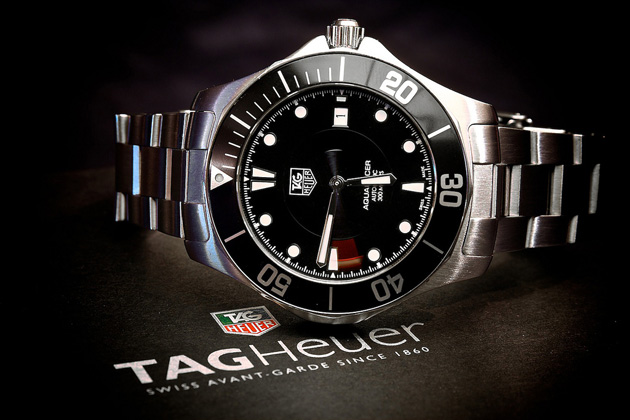
We weren’t — and, by and large, still aren’t — sure what Tag Heuer would look to do for their first Android Wear smart watch when plans for them to make one were revealed, but Bloomberg’s latest report sheds a bit more light. First thing’s first: this thing won’t be cheap. Tag Heuer’s base price is set to start at ,400. That’s nowhere near the ,000+ Apple Watch – Watch Edition, but at least their bottom tier product comes in at at more manageable price point.
That said, Tag Heuer is a bit different compared to the likes of Apple, Motorola and LG. Watches are their expertise — their only expertise — and they know the area better than anyone else. While the engineering needed to make a smart watch probably isn’t quite as intricate as a mechanical watch, they will still likely take great care to craft a chassis with great precision and using nothing but the most premium materials.
An executive from Tag Heuer — Jean-Claude Biver — went on to comment that the watch will have 40 hours of battery life, which is just shy of the 2-day average we typically like to see but far better than the 18 hours you can pull on an Apple Watch. He also mentioned that despite being new competitors he hopes Apple does sell a ton of smart watches for the simple sake of growing the market and demand for these things.
Just goes to show that there are still some companies out there who value and embrace the spirit of true competition. Tag Heuer’s smart watch isn’t due until October or November so we imagine we’re still a long way out from seeing what’s in store.
Though it is nearing the two-year anniversary of its release, the Nexus 5 remains a great option for users looking for a truly pure Android experience. Couple the phone with unlimited talk and text service for a year (including visual voicemail and tethering) and 500MB of LTE data per month and you’ve got yourself quite the package.
To say we’re over Lollipop and its shenanigans would be an understatement. Right now, we got our eyes locked on Android M and all the improvements and polish the future Android update looks to bring to the platform. There’s a lot of stuff being uncovered almost everyday — and we’ve shown you much of that already. — but if you’re wondering what Android M has in store for tablet user, it seems Google’s got your back.
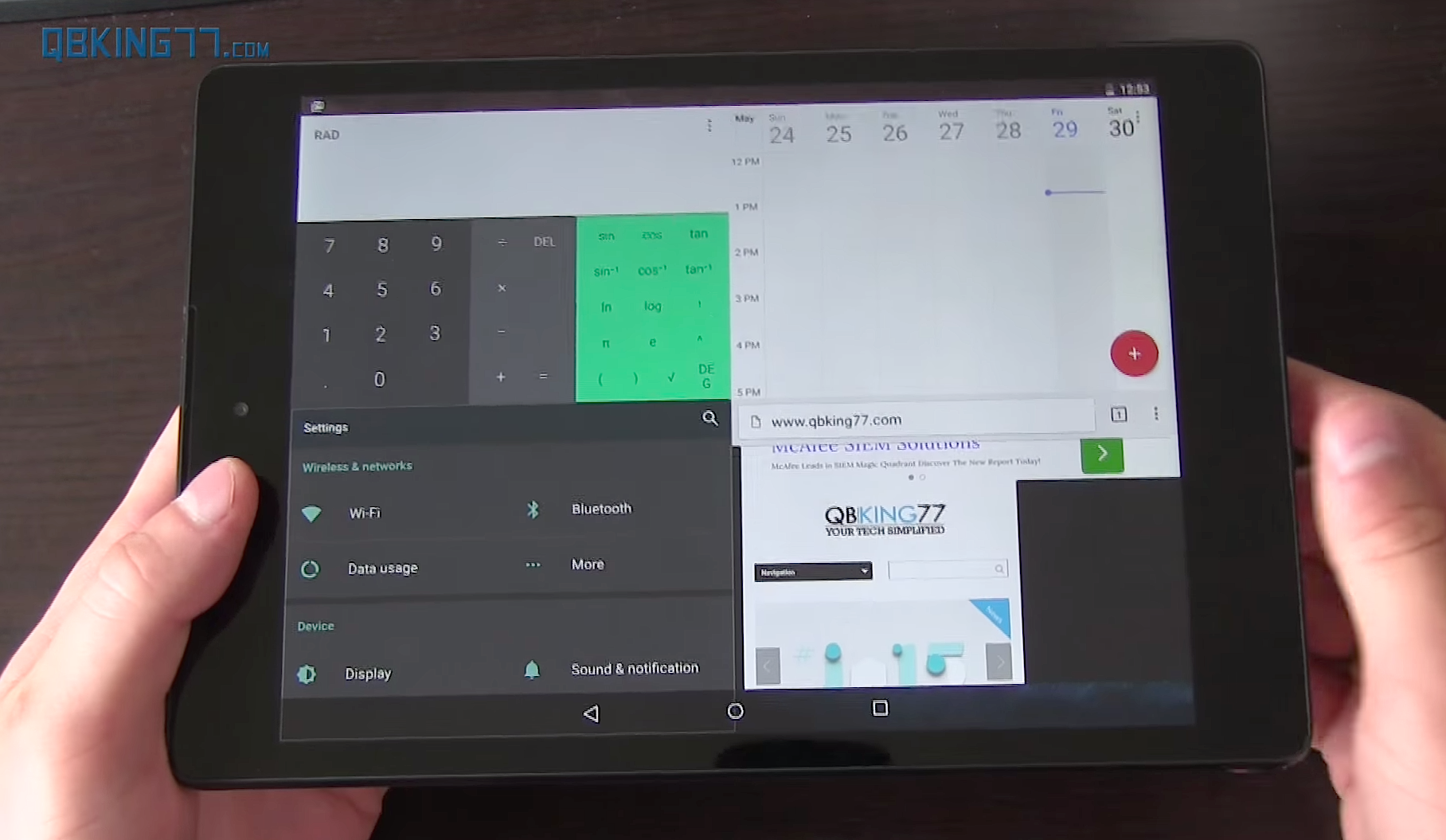
Our friend Tim Schofield, better known around Android circles as Qbking77, uploaded a video showing off some much needed features heading to the Android M release. He discovered that the default Google keyboard actually features a split typing mode for use on tablets where your thumbs have trouble reaching all the keys. It doesn’t appear to be available for smartphones, even ones as big as the Nexus 6 but that could change in the future.
There was also an all new multi-window mode that actually isn’t available in any of the settings by default, but can be added only after tinkering around with the build.prop. Once the necessary changes have been made, the new setting can be toggled in the Developer options. It works pretty well even in this early state, with a button that appears in an app’s title bar whenever opening Android’s recents menu.
When pressed, a menu pops up asking you to specify the layout. It’s a little “hack-ie,” but we’re sure it’ll be polished up in time for M’s release later this year. We were actually surprised at how well everything worked. Even with 4 apps open at the same time, scrolling was smooth and everything loaded up quick.
Other small improvements like the notification shade the moves around the top depending on where you initiate the pull down gesture is also a nice touch. It’s surprising really. All these changes are somewhat small but when combined, make for an OS update that already has us drooling. Why these couldn’t have been included in Android Lollipop is anyone’s guess, but given Lollipop’s dramatic UI overhaul, I’m sure they just didn’t have time. We will admit, it’s nice seeing Google — who typically takes the bare bones approach with their apps — going this extra mile to add more user customizations like this. Choice is good. Check out Tim’s full video down below.
Out of all the Google projects, Project Tango is probably the one that gets the least amount of attention around the blogosphere. That probably has something to do with the fact that it’s so developer focused and its real world applications aren’t so easily visualized when it comes to consumer devices.
What is Project Tango, you ask? Well, according to Larry Yang, Project Tango’s lead product manager, it’s as a computer vision-based platform that gives mobile devices the ability to, not only sense their location within a space, but identify objects around them as well. This gives devices the ability to navigate around indoors purely by sight. No WiFi, GPS, or Bluetooth beacons necessary.
During this year’s Google I/O, Google announced a new smartphone reference platform for Project Tango. The device is powered by a Qualcomm Snapdragon 810 and equipped with a 3D depth sensing camera. It’s not for the everyday man, but meant to give developers the tools they need to start building exciting new applications and products.
While real-world use cases can be anything from furniture modeling to extremely accurate and advanced augmented reality. But probably the most interesting application is in gaming, where all these things come into play. In fact, Yang showed us toy gun built by Hasbro that tracks the players location and movement, mirroring that in the virtual world.
Google says they’ve sold around 3,000 units of their NVIDIA powered tablet which recently went on sale in the Google Store earlier this week for 2. With the lower price tag, removal of the invitation restrictions, and the new smartphone platform launching this summer, we should see more developer interest in Project Tango. We’re definitely curious to see where Tango ends up in the future.
Hot of the heels of Google I/O 2015, Google’s Design Team is ready to talk about, what else, but design. During I/O, they gave their entire site a fresh new Material design overhaul. As most of you know, Material is Google’s new design language that was introduced last year in Android 5.0 Lollipop and bled out into all of Google’s web services.
Material design focuses on clean, minimal design with bold colors and typography that emphasize depth and are brought to life with gorgeous animations. Still confused? Simply put, it’s a lot like paper. Well, maybe the Google design team can explain it better in their latest video:
While we’re just now seeing more and more Android apps follow this design philosophy, some definitely do it better than others. There’s no better way to show what Material Design is than by simply showing you. That’s why Google’s Material Design team decided to showcase their favorite apps adhering to their guidelines in a new featured page in the Google Play Store.
There’s 18 apps total ranging from fitness to messaging and everything in between but Google hand-picked 6 which they felt excelled in specific areas for their first ever “Material Design Awards.” Here are the top picks:
ASUS showed up at Computex 2015 as they always do (considering it’s the premier tech event in their own backyard of Taiwan), and they didn’t disappoint with a few nice announcements. One of the devices on tap was a new smart watch.
It’s the ASUS ZenWatch 2, and the rumors were true. ASUS cooked up 2 different sizes, one for those who prefer a little bulk and the more petite option that most women might prefer. The company is still going with a square watch face, though the chassis isn’t without a round nature.
The ZenWatch 2 features a physical dial (which we imagine can be used to navigate the system), an OLED display, a Qualcomm Snapdragon processor, Gorilla Glass 3 and IP67 specification for dust and water resistance. You get a magnetic mechanism for charging the device, which is a great feature as no one wants to have to clasp their smart watch into a bothersome cradle every night.
On the presentation side, there will be a wide range of wrist bands available post-launch — some in rubber, leather and even a special edition Swarovski set featuring actual Swarovski crystyals — though the device comes with stainless steel straps as standard.
For software, you can expect the latest version of Android Wear and improved wellness and remote camera apps, though ASUS didn’t go into detail about what, exactly, was different. We’re not sure if the watch will support Android Wear’s new WiFi support (the initial spec list doesn’t mention one) so we’ll have to dig for more to see if this thing can offer the same level of connectivity as LG’s Watch Urbane.
And that’s about all we know. ASUS didn’t have pricing or availability to mention, which makes us feel as if we won’t be seeing a product ready to buy until late Q3 at best. Let’s hope we’re wrong, though, because the ZenWatch 2 doesn’t look half bad.
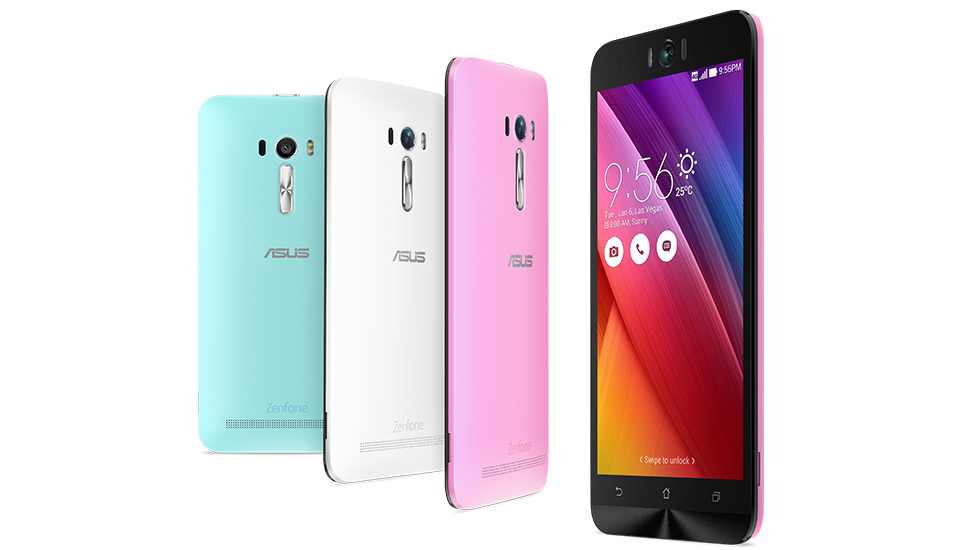
ASUS had a new phone to flaunt at their Computex 2015 showing. Dubbed ZenFone Selfie, this mid-range darling takes its design cues from the ASUS ZenFone 2, but adds a 13 megapixel front-facing camera that has its own dedicated dual-tone flash. The lens is f/2.2 aperture and features a wide angle field of view to make sure you can fit you (and anyone else) into the shot with ease.
Beyond that, it’s pretty much a run of the mill smartphone, including a 5.5-inch 1080p display and Qualcomm’s octa-core 64-bit Snapdragon 615 chipset (which is interesting considering they went all-in with Intel for the launch of the ZenFone 2).
Unfortunately we don’t get many details on the other specs. The company didn’t even bother to mention the rear camera, though we’re betting it’s at least as good as the front-facing variant. They also showed off the “Selfie Swing,” a detachable bumper that can help you extend the phone in front of you to get more in your shot.
It also seemingly doubles as a kickstand, a feature that isn’t on nearly enough smartphones in today’s age. You can see a GIF of the Selfie Swing attachment below, courtesy of Engadget.
No pricing and availability yet, but we don’t doubt ASUS we will tell us when they know for sure.
ASUS has had quite the day at Computex. we got a new smart watch and a selfie phone, and you can bet they have a good crop of tablets on the way, as well. This is the ASUS ZenPad 8.0, an 8-inch tablet that can either be very affordable or pack a whole lot of punch (depending on which you fancy).
There’s the base model — simply dubbed the ASUS ZenPad 8.0 — that has a 1280 x 800 display, 16GB of internal storage, an Intel Atom X3 chipset, a 5 megapixel rear camera and more. Not bad for those on a modest budget.
What really gets us excited is the ASUS ZenPad S 8.0, which is a whole different beast. This thing packs Intel’s Atom Z3580 chipset (top-line stuff for their mobile line), 4GB of RAM, 2,048 x 1536 resolution, your choice of 16GB or 32GB of internal storage, a 5 megapixel rear camera, a 2 megapixel front camera and USB Type-C. We’re sure it’s going to be more of a wallet buster than its weaker brother, but with these specs (and ASUS’s history for quality) we’d argue it’ll be worth it.
ASUS also has 7-inch and 10-inch models planned, but the company hasn’t yet released any details about them. We’ll expect the 7-inch variant to be on the affordable side, while they’re bound to go balls to the walls for the biggest option. Unfortunately all we can do is speculate until they unleash some details or we stumble upon some juicy leaks. Either way, the 8-inch tablets are enough to satisfy our undying need for new tech for the time being.
OnePlus is trying to move some units of their first smartphone this week. The company has announced a series of flash sales that will go off this week. We already know what the sale will entail, too: they’ll be taking off the cost of either the 16GB Sandstone Black or 64GB Silk White, which are price tags of 0 and 0, respectively.
The catch? These sales will only pop up at brief moments, so you’ll need to be at the ready to order one. Thankfully the company gave us a cheat sheet on the times that the deals will go live. Here’s the full list:
June 1 – 12:00 GMT (8 am EST)
June 2 – 2:00 GMT (10 pm EST -1 day)
June 3 – 12:00 GMT (8 am EST)
June 4 – 2:00 GMT (10 pm EST -1 day)
June 5 – 12:00 GMT (8 am EST)
June 6 – 2:00 GMT (10 pm EST -1 day)
June 7 – 12:00 GMT (8 am EST)
As you can see, the times alternate each day to to account for different regions, or for people who might not be able to get to their computer to order one at a certain time. Pick a day that works best for you and make sure you’re there!
We should also note that stock for this promotion is limited on a daily basis. For instance, the 64GB Sandstone Black model is still available today, however the Silk White model is already sold out (more will be available during tomorrow’s promotion). That means you’ll want to pick the soonest day and time you can to make sure you can be on OnePlus’s website right when the floodgates open. Knowing all that, you can head right here to buy one if you’re interested.