Affichage des articles dont le libellé est platform. Afficher tous les articles

lundi 6 juillet 2015

Google could be working on a telemeeting platform called “GMeet”


google meetings gmeet


Teleconferencing is all the rage with businesses in the internet age, and Google is just as poised as anyone to provide a platform suitable for the types of corporate meetings that have to take place in such a manner. If Hangouts video calling wasn’t already enough, the company could be working on a standalone platform meant specifically for businesses.


Google+ user (Google+er?) Florian Kiersch stumbled across a new app in the works by Google called GMeet, or Google Meeting. Details are largely unclear at this time, but from the outside looking in the app doesn’t seem all that different from something such as Goto Meeting. You sign in, you join a meeting, and you (presumably) conference over voice and/or video.
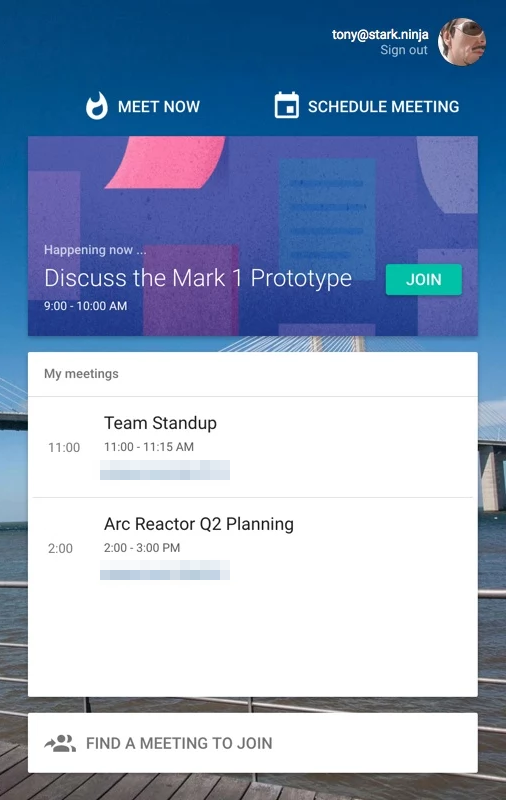

gmeet-2Kiersch says the app only accepts Googler logins right now, so it’s unclear if this is a tool meant for internal use by Google or if it’s a user-facing service where the prerequisite only exists to make sure prying eyes can’t get an early look at what’s inside ahead of any official announcement.


Searches for G Meet and Google Meeting pull up interesting anecdotes and code snippets from as far back as 2011, but most of the code references things we already have access to in the latest rendition of Hangouts, such as whiteboards, screen sharing, and integration with Google Calendar. A URL that once existed in the code (google.com/talk/meet) also now redirects to Hangouts’ main landing page.


A standalone meeting app would likely use Hangouts technology for its backbone so there’s nothing out of the ordinary than meets the eye. But until we can get into the app for ourselves or get an announcement from Google, we’re left to our educated guesses. Let’s hope to hear more in the very near future!


[Thanks, Florian!]


“Android Pay” likely to be introduced as a full-blown wireless payments platform at Google I/O


Nexus 7 Google Wallet 2


Before you freak out, no — Google Wallet is not dying. In fact, it might actually get better. Google’s Sundar Pichai spoke at Mobile World Congress in Barcelona this morning about the company’s plans for mobile payments in the future. This comes at a time where Apple and now Samsung have thrown their hats into the arena with exciting platforms of their own.


Google Wallet in the now slightly pales in comparison to those guys, but Android Pay will hopefully look to change that. The first thing to know is that Android Pay won’t actually replace Google Wallet.


Instead it’s a full-blown payment platform and API that Google and third-party developers alike can tap into. Google Wallet will likely still exist as its own app and service, but Google will use Android Pay as the backbone. Don’t like Google Wallet? Another developer could come along and do things differently, but still enjoy the same secure backbone that Google uses with little issue and you’d be free to give that service a go if you so wish.


For its part, Google says they aren’t necessarily threatened by Samsung’s move to enter the wireless payment space. In fact, Google hopes the two can work together in some way and get the idea of wireless payments into the hands, pockets and minds of more people. Google has a leg up on Samsung thanks to their acquisition of Softcard (formerly ISIS) which is already backed by most of the United Stats’ major carriers.


Unfortunately that’s all we know at this point. We’re not sure what other plans Google has to affect the wireless payment scenes in a powerful way, but we should be treated to more details once Google I/O arrives.


Up close with Google and Qualcomm’s new Project Tango smartphone platform [VIDEO]


project-tango-qualcomm-phone-back


Out of all the Google projects, Project Tango is probably the one that gets the least amount of attention around the blogosphere. That probably has something to do with the fact that it’s so developer focused and its real world applications aren’t so easily visualized when it comes to consumer devices.


What is Project Tango, you ask? Well, according to Larry Yang, Project Tango’s lead product manager, it’s as a computer vision-based platform that gives mobile devices the ability to, not only sense their location within a space, but identify objects around them as well. This gives devices the ability to navigate around indoors purely by sight. No WiFi, GPS, or Bluetooth beacons necessary.


project-tango-dev-tool-ui


During this year’s Google I/O, Google announced a new smartphone reference platform for Project Tango. The device is powered by a Qualcomm Snapdragon 810 and equipped with a 3D depth sensing camera. It’s not for the everyday man, but meant to give developers the tools they need to start building exciting new applications and products.


project-tango-qualcomm-phone-front


While real-world use cases can be anything from furniture modeling to extremely accurate and advanced augmented reality. But probably the most interesting application is in gaming, where all these things come into play. In fact, Yang showed us toy gun built by Hasbro that tracks the players location and movement, mirroring that in the virtual world.


project-tango-demo-game


Google says they’ve sold around 3,000 units of their NVIDIA powered tablet which recently went on sale in the Google Store earlier this week for 2. With the lower price tag, removal of the invitation restrictions, and the new smartphone platform launching this summer, we should see more developer interest in Project Tango. We’re definitely curious to see where Tango ends up in the future.


Samsung introduces Arduino-like open development platform named ARTIK


Samsung logo DSC08657


Samsung has introduced a new compact development board system for developers interested in making products for the booming “Internet of Things” category. It’s called Artik, and it’s essentially an Arduino-like platform that’ll equip developers with the sensors and tools needed to prototype internet-connected devices.


samsung artik


Artik isn’t very special in that regard, save for the fact that it’s an open platform with no proprietary bits holding you back. Samsung Artik also emphasizes the use of wireless communication sensors where many Arduino boards don’t.


Samsung will have three different modules available at launch depending on what you’re yearning for:


  • ARTIK 1, the smallest IoT module currently available in the industry at 12mm-by-12mm combines Bluetooth/BLE connectivity and a nine-axis sensor with best-in-class compute capabilities and power consumption. It is specifically designed for low-power, small form- factor IoT applications.

  • ARTIK 5 delivers an outstanding balance of size, power and price-performance and is ideal for home hubs, drones and high-end wearables. It incorporates a 1GHz dual-core processor and on-board DRAM and flash memory.

  • ARTIK 10 delivers advanced capabilities and high-performance to IoT with an eight-core processor, full 1080p video decoding/encoding, 5.1 audio and 2GB DRAM along with 16GB flash memory. The Samsung ARTIK 10 includes Wi-Fi, Bluetooth/BLE and ZigBee connectivity and is designed for use with home servers, media applications, and in industrial settings.


Unfortunately the platform isn’t quite ready for general availability just yet, though developers interested in trying it out in the early going can apply for Samsung’s Alpha Developer Kit right here.


[via Samsung Artik]


Google reportedly re-introducing Android-based home platform codenamed Brillo at I/O 2015


Android At Home banner


You can walk into any hardware store and find smartphone-controlled light bulbs, but yet we haven’t seen much from Google’s home automation project — Android@Home — since it first debuted at Google I/O 2012. It’s been a good couple of years since then and we’ve seen Google take a few strides in that direction with their recent acquisitions of Nest and Dropcam.


Soon, just about every electronic device will find itself connected to the internet, something Silicon Valley is calling the Internet of Things. Because Android (at least in its current state), isn’t really optimized for low-power gadgets and doodads, Google is doing something about that with a new software codenamed “Brillo.”


Although we’re not entirely sure if it will be Android-based, it’s being worked on by Google’s Android unit so it only makes sense. The difference is that Brillo will reportedly have no problem running on as little as 64MB or 32MB of RAM, much way less than the 512MB minimum Android can run on right now. The aim is to make every electronic device in the entire home “smart” — microwaves, refrigerators, washer/dryers/ — and the best way to do that is by connecting them to the web.


While smart slow cookers and other appliances haven’t really taken off in recent years, home automation is becoming cheaper and more practical than ever. Hopefully we’ll learn more at Google I/O in a few short weeks.


[The Information]


Groupon To Go is an upcoming online ordering platform that looks to give GrubHub, OrderUp a run for their money


Groupon To Go banner


Groupon was all the rage when it launched back in 2008, one of the internet’s first daily deals sites that offered up discounted gift certificates on local food or activities. A few years later, the company began to fizzle out, reporting quarterly losses in the millions of dollars range.


Recently, we’ve seen Groupon branch out its business into new areas with a new app called Snap by Groupon that rewards shoppers with real cash instead of coupons. But it appears that’s not all Groupon has up their sleeve, with a new online ordering platform called “Groupon To Go” set to kick off sometime in the near future.


Groupon To Go screenshot 1


It doesn’t appear Groupon has made anything official yet, but the landing site is already live. There aren’t any deals populating it quite yet, but we discovered Groupon is already hiring To Go management positions in the Chicago area and recently picked up a trademark for their service so we’d imagine it’s coming very soon.


Groupon To Go ordering


Once launched, Groupon To Go will let users search for local businesses offering up delivery in their area. It’s not too unlike services like GrubHub or OrderUp with Groupon acting as the middle man by digitizing participating restaurants’ menus and giving them their own business page on Groupon.com.


Once orders are received, Groupon will send them to businesses either by fax, email, or through their online merchant center. If restaurants want to further drive business, they can even create deals that will be broadcasted across Groupon’s online site, email news letters, and mobile apps.


Groupon To Go order merchant


It’s an interesting entry into the food delivery market and with Groupon’s already huge user base, should be enticing to both customers and businesses alike. We expect to learn more once the service officially launches, but in the meantime, you can watch their promo video for business on Vimeo.


Amazon Echo’s Alexa becomes an open platform to add a digital assistant to any smart item


Amazon_Echo_Review


It looks like Amazon had bigger plans for Alexa than we thought. The digital voice assistant — which is the star of the show for the Amazon Echo that recently went up for pre-sale — is becoming an open platform which developers can use to add voice assistant features to their products.


They’ll do so through the use of the Alexa Skill Kit and the Alexa Voice Service, a collection of APIs and services that’ll allow you to implement Alexa in your products with ease. The Skill Kit is what will allow developers to support Alexa as if their app is one of Amazon’s own, while the Voice Service is what device makers use to implement Alexa in internet-connected hardware.


To kick things off and spur development, Amazon is also putting up a cool 0 million — called the Alexa Fund — to promote development of Alexa apps, devices and give startups the tools they need to be successful with it.


Amazon’s hope is that the end-result will be a wide range of Alexa-capable products that can make your smart home smarter than it already is, and without the need to buy their homegrown unit to do it.


Exciting times ahead indeed, and we can’t wait to see what comes of it. You can take a look at our Amazon Echo review to learn more about Alexa and how it can help you stay on task and up to date on everything in life.