Affichage des articles dont le libellé est Preview. Afficher tous les articles

lundi 6 juillet 2015

11 Android M Wallpapers from the Developer Preview


The Google IO 2015 Keynote came and went and we’ve shared with you all the big news. Now that the Android M developer preview is out in the wild, we’ve got the Android faithful flashing Android M in the forums and digging it apart for all the nitty gritty goodies.


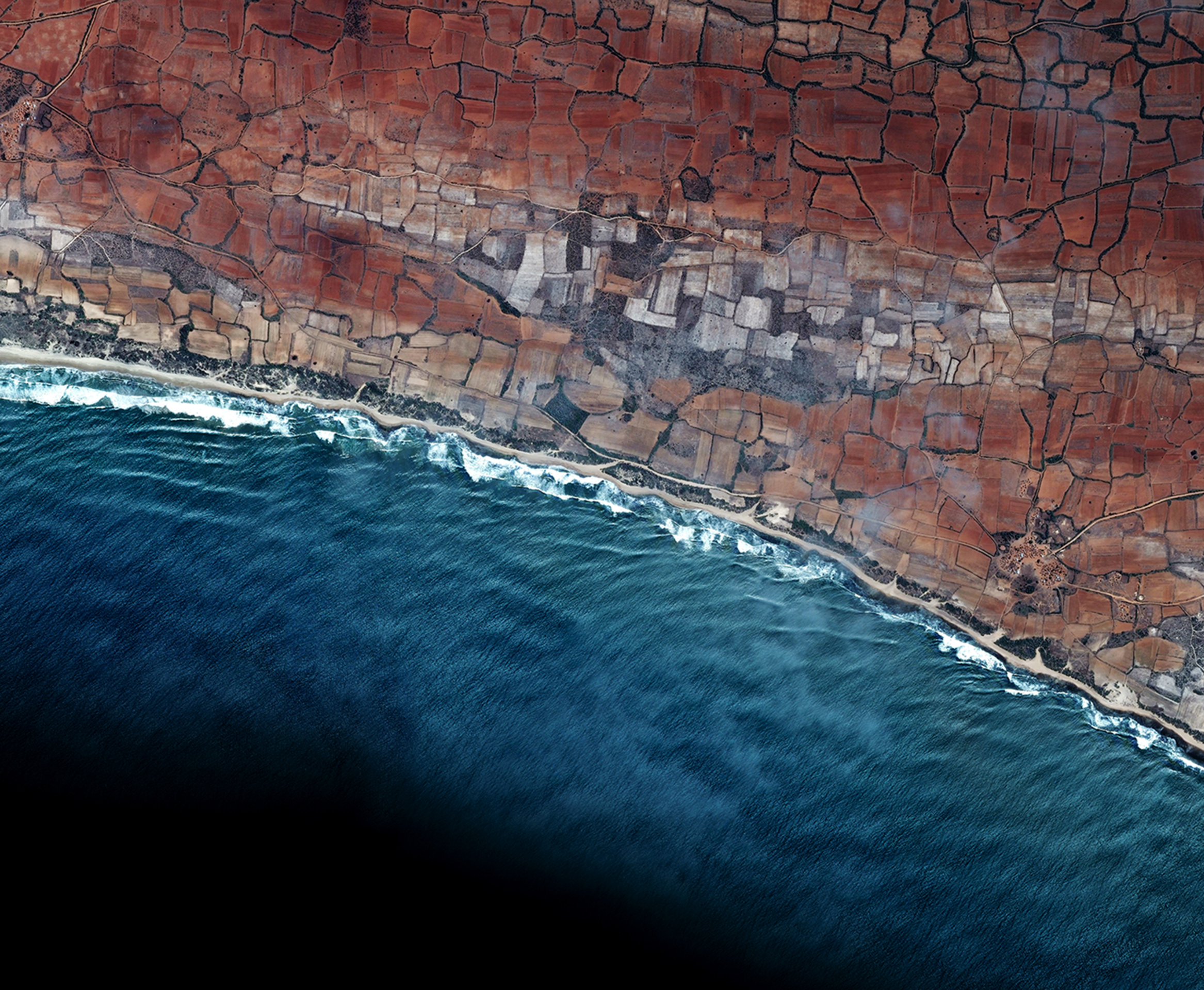
Among them, without fail, is a collection of the default wallpapers. Unfortunately, (at this point) there is only 1 new wallpaper found in Android M:


max frame and edited


The lone new wallpaper appears to be a picture of earth taken from space – just another reason to think that Android M won’t be called Marshmallow but instead will be called Android Milky Way.


Here are the other 10 default wallpapers found on the developer preview of Android M (but that also appeared in Android L):


wp_arc_001-phandroid wp_arc_003-phandroid  wp_geo_1243-phandroid wp_geo_1557-phandroid wp_geo_2102-phandroid wp_geo_2167-phandroid wp_geo_2170-phandroid wp_geo_2278-phandroid wp_paper_001-phandroid


wp_arc_004-phandroid


Stay glued to Phandroid for more exclusive coverage of Google IO 2015!


[Thanks Chris!]


How to customize the Quick Settings Panel on the Android M Developer Preview [VIDEO]


android m quick settings customization


Yesterday it was revealed that you can now rearrange the quick settings toggles in the Android M developer preview. It’s not a groundbreaking feature, but people have different tastes and needs so it’s certainly something we’ll all come to appreciate.


If you happen to have the developer preview loaded on one of your Nexus devices and want to try this out, here’s a quick and easy guide. You can follow the video above, or take heed to the following steps:


  1. Make sure you enable the Developer Options menu. This can be done by going to Settings > About Phone. From there, scroll to the build number and tap it really fast until the phone tells you you’re a developer.

  2. Head back to Settings > Developer Options and find the Show SystemUI Tuner option. Make sure the toggle is set to on.

  3. Now go to Settings > System UI Tuner, and you’ll see an option called Quick Settings. Select it.

  4. Here you can remove and add tiles as you see fit. To remove a tile, perform a long-press on it and drag it down to the bottom. To add, press the “Add Tile” button at the bottom.


And once you’ve gotten everything the way you want it, head to notifications to see your Quick Settings panel exactly the way you want it. Unfortunately the Android M developer preview is still a bit buggy, so trying to rearrange tiles in the exact order you want doesn’t seem to work just yet, but we’re hopeful all of that will be squared away by the time this thing is ready for production.


How to enable the Light or Dark Theme on the Android M Developer Preview [VIDEO]


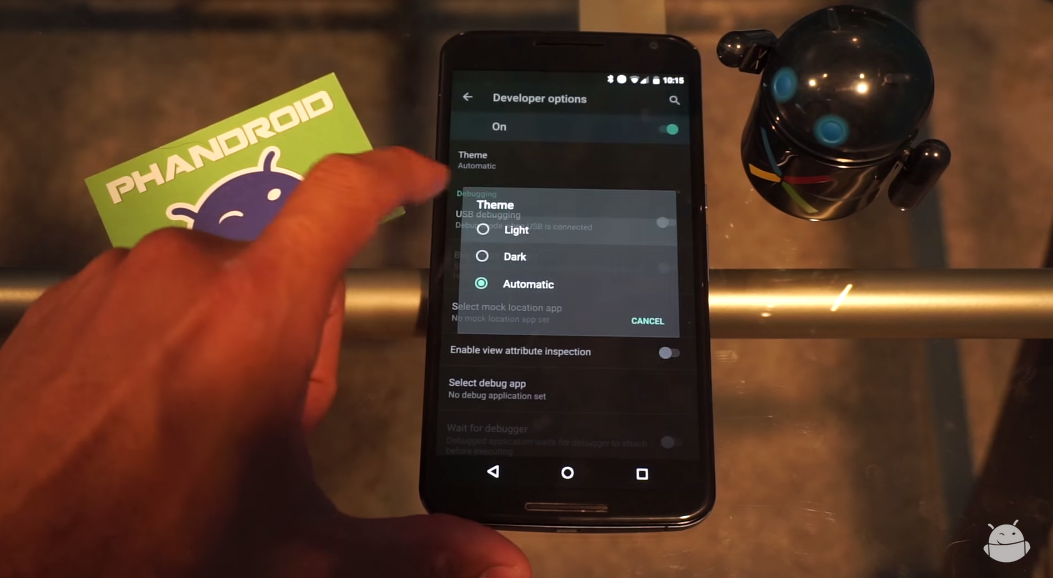
android m theme options


One of the cool things that popped up in the Android M developer preview was the ability to switch between a light or dark theme. It’s nothing drastic — system UI elements and menus become either light text on dark background or dark text on light background — but it’s a nice little added bit of customization for those who can’t stand one or the other.


So how do you enable it? It’s very simple, and a quick 2 minute viewing of the video above shows you exactly how. Can’t watch it? Here’s a quick rundown of what you need to do to get going:


  1. Make sure you enable the Developer Options menu. This can be done by going to Settings > About Phone. From there, scroll to the build number and tap it really fast until the phone tells you you’re a developer.

  2. Head back to Settings > Developer Options and find the Theme option.

  3. In the resulting dialog box, select between Light, Dark or Automatic.


And there you have it. We’re still a bit unsure on what the “Automatic” setting does. It’s possible this option will choose between Light or Dark depending on factors such as time of day or a reading from the ambient light sensor. We’re still testing it out, and we’ll be sure to let you know if we find anything.


Of course, it’s entirely possible that this setting does not yet do anything as this is a developer preview and things aren’t guaranteed to work 100% the way they’re meant to. In any case, give it a go if you have the Android M developer preview on your Nexus device!


Galaxy S6 and S6 Edge: How to stop text messages from displaying a preview in the notification bar


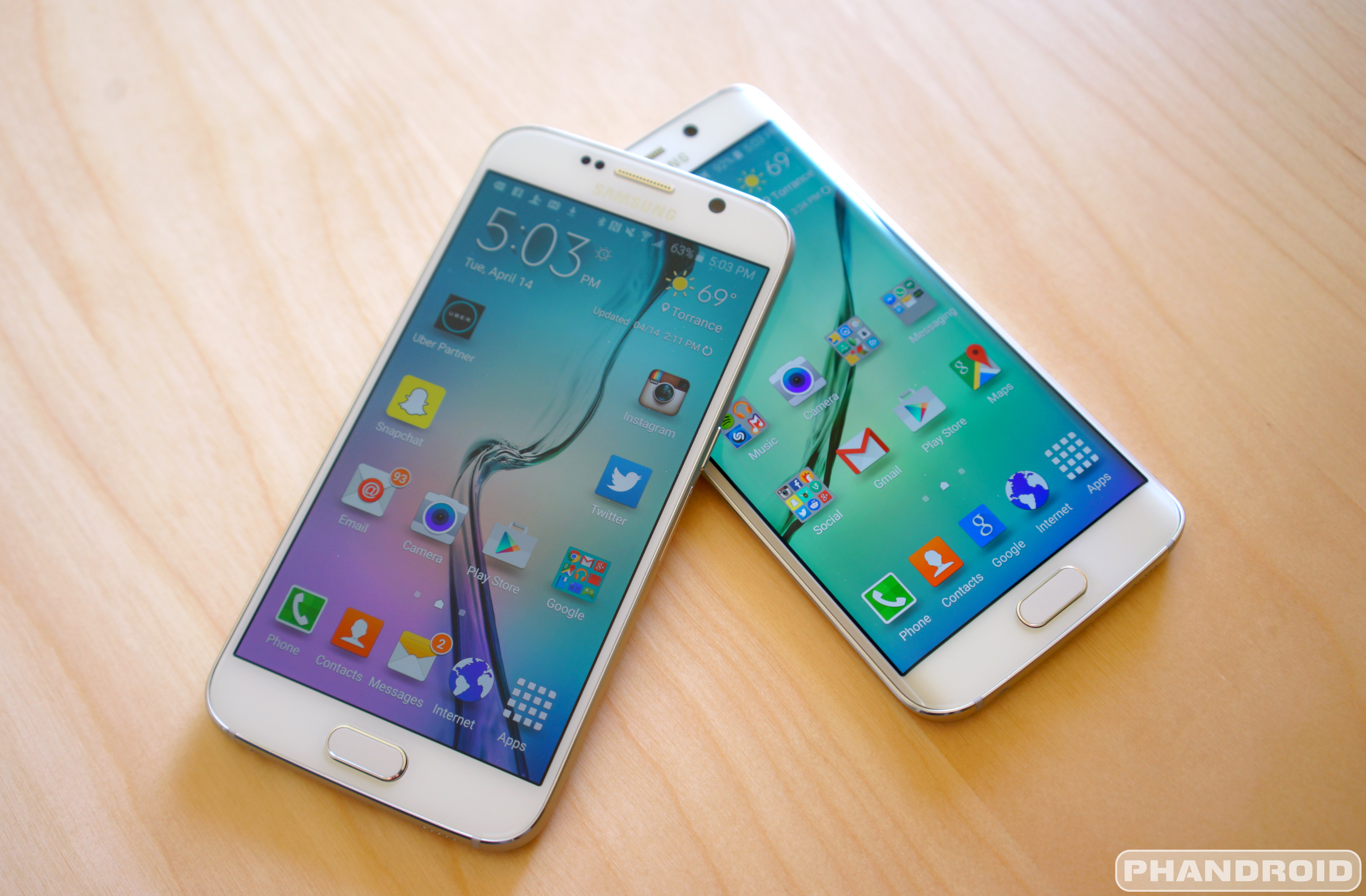
Samsung Galaxy S6 DSC09327


There’s nothing more embarrassing than receiving an inappropriate text message while your boss is going over the company’s latest expense reports. Whether it’s a meme or just a “sensitive” topic of discussion, some things are better left not blasted all over your phone, especially in a professional work environment or church setting.


Samsung Galaxy S6 popup notification messages ticker


On the Samsung Galaxy S6 and Samsung Galaxy S6 Edge, receiving text messages through the default Messages app will display its contents on your lock screen, in a popup message, and inside your notification bar via ticker. Pretty much all over your phone. While this can be convenient, it leaves the contents of your messages in plain view during times when you may not want them to be.


Because some of Android’s newer users may have difficulty finding an easy fix, we’ve decided to give you the full rundown on a few solutions with some help from our friends at AndroidForums.com. Check it out.


Turn off the Pop-up display (Easy)


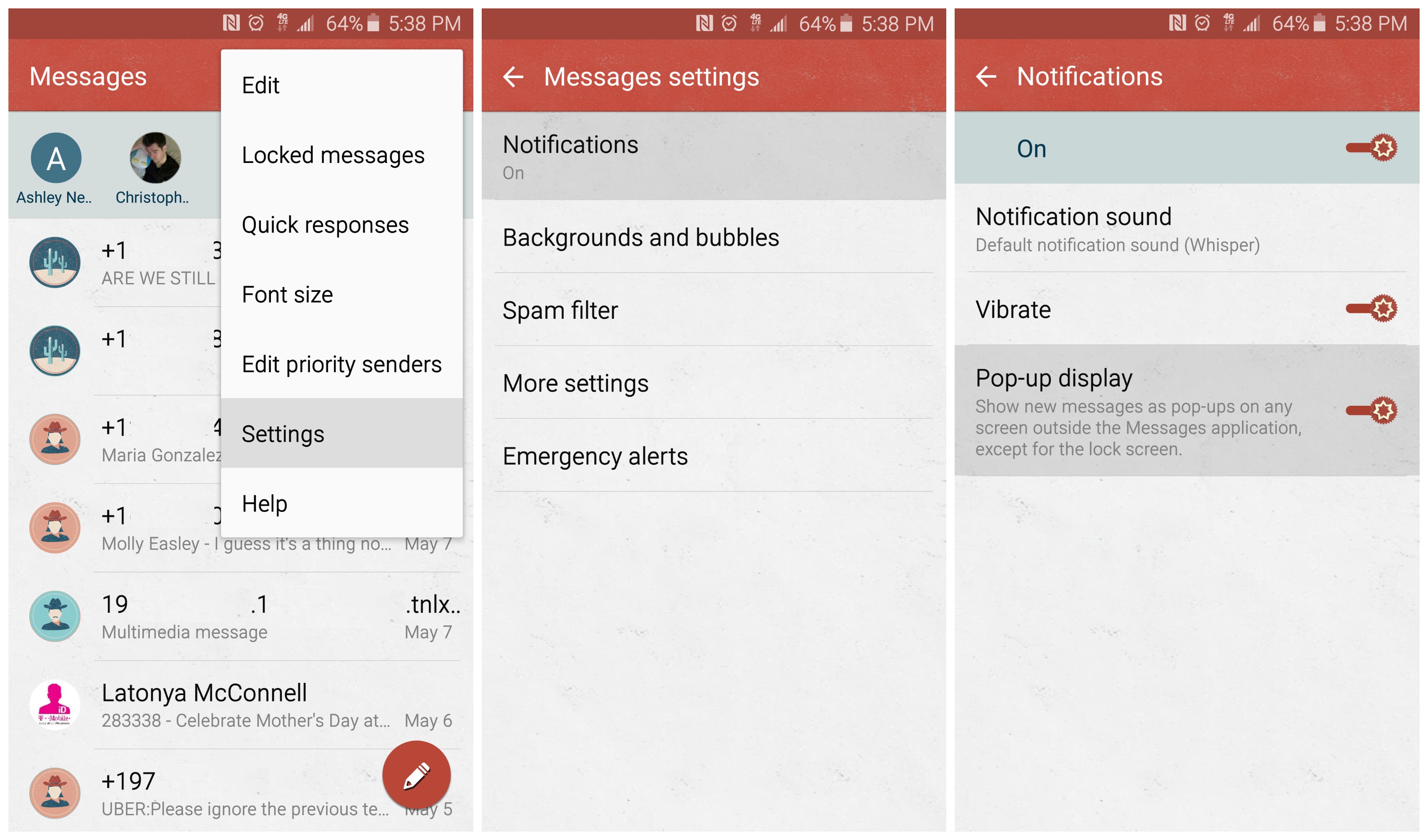
Samsung Galaxy S6 turn off popup messages


If it’s only the popup messages from the Messages app that are posing a problem, you can easily turn them off in the stock app’s settings. Simply open the Messages app and select “More” in the upper right corner. From there select Settings, Notifications, and Pop-up display to turn off the popup.


Keep in mind that while this will turn off the popup message from displaying while you are in other apps or watching full-screen video, it wont do anything to stop your messages and all their contents from being displayed in the lock screen or the notification bar. Don’t worry, we’ll tackle those next.


Turn of all lock screen notifications (Overkill)


Samsung Galaxy S6 lock screen notifications


When dealing with the lock screen, it’s possible to disable all notifications from appearing on there. This may sound perfectly fine to some of you, but for others this overkill as you will no longer see notifications from any of your other apps as well (Facebook, Email, Hangouts, Snapchat, etc.).


If you’re okay with that, simply open your Galaxy S6’s Settings app (it’s the gear icon in the upper right corner after pulling down the notification shade), scroll down to Sounds and Notifications, then Notifications on the lock screen and select Do not show notifications. Simple as that.


Use a 3rd party app to hide all content inside text messages (Best)


Samsung Galaxy S6 text messages notification bar Chomp SMS


The easiest — and best way — to stop text messages from showing a preview of its content on your device (lock screen and in the notification bar) is to simply download one of the many 3rd party apps found in the Google Play Store. There are plenty to choose from, but Chomp SMS is one of our personal favorites as it features a handy option to hide content from displaying in the notification bar and lock screen, but still notify you when a message is received.


Simply download the free application from the Google Play Store and upon opening the app, you’ll see the option to “MAKE DEFAULT APP” along the top. Tap it, and a popup dialog will ask if you’d like to set Chomp as your default messaging app. Select yes, then go to Settings > Notifications > Show Ticker and un-select it.


Now, whenever you receive a new text message, Chomp will only display an an icon in the notification area — not the ticker with the entire message contents. Why every messaging app doesn’t have this option is beyond us. You can find a link to Chomp SMS via the widget down below. Enjoy.


How to enable or disable App Permissions on the Android M Developer Preview [VIDEO]


android m app permissions


Google was met with a round of applause during their keynote yesterday when they announced Android M would give users more control over the device permissions apps can request. The new system allows you to grant or revoke access on a granular basis, so you choose whether to grant an app access to the microphone, or your camera, or your location or contacts.


Those who have flashed the Android M developer preview will be able to start controlling permissions right away, even in apps that haven’t been designed for it. Here’s how you can go about doing that.


  1. To start, head to Settings > App and find an app which you want to work with. Select it.

  2. Tap App Permissions on the App Info screen.

  3. You will see a list of permissions the app requests, and whether those permissions are toggled on or off. Tap the toggle to customize the setting.


Note that you may get a warning letting you know that some apps which don’t natively implement the new permissions might break as a result of disabling or enabling. If that happens, just use the steps above to go back and turn the permission back on. The only thing left to do is to rejoice now that you have the final say over which device functions an app is allowed to use.


Download the Microsoft Word, Excel and Powerpoint preview apps on your Android phone


microsoft office for android phones preview


Microsoft has today announced that the phone-specific versions of their Office apps are ready for public preview, and that you can download them right now. You’ll be getting Excel, Word and Powerpoint in user interfaces fit for the smaller screen of a phone.


So what do you have to do to download them? Simple:


And that’s it! Prior experience with Microsoft previews tell us there shouldn’t be much to worry about in terms of stability here, and that it won’t be long before we see a general release if no major issues pop up. That said, if you simply can’t wait for general availability then this is the fastest way to get Microsoft’s Office apps on your Android phone.


[via Google+]


Sony releases Android M Developer Preview for select Xperia devices, here’s the full list


Sony Xperia Android M developer preview


While nowhere near final software, the Android M Developer Preview is a great way for devs to test drive the next version of Android before it’s officially released at the end of the year. That’s why Google introduced the program back when Android L (Lollipop) was first unveiled during last year’s Google I/O.


Normally, we don’t expect to see a developer preview running on much, not outside of officially supported Nexus devices or 3rd party custom ROMs. Today, the folks at Sony Mobile are now giving developers a shot at trying it on their Xperia devices as part of Sony’s Open Device program.


Willing developers can now create a test image for themselves and flash it onto their Xperia devices providing they have a knowledge in these things. There’s a fair amount of officially supported devices and Sony Mobile was even nice enough to provide a quick guide for those that needed a refresher. For those curious, here’s the full running list:


  • Xperia Z3

  • Xperia Z3 Compact

  • Xperia Z3 Tablet Compact

  • Xperia Z2

  • Xperia Z2 Tablet

  • Xperia Z1

  • Xperia Z1 Compact

  • Xperia Z Ultra

  • Xperia E3

  • Xperia M2

  • Xperia T2 Ultra

  • Xperia T3


We should note, Sony also cautioned users that the AOSP software isn’t certified or intended for daily use (modem and camera aren’t working), so you probably shouldn’t go flashing this on your daily driver. If that hasn’t scared you away yet, feel free to hit up the source link for more.


[Sony]