It’s been a while since we last heard rumors of Microsoft’s Cortana coming to Android. Way back in June of 2014 a manager from the Windows Phone team talked about the possibility of Cortana coming to other platforms. Now we’re hearing from Microsoft’s Eric Horvitz, managing director of Microsoft Research, that they are planning a bigger roll-out for Cortana later this year.
Microsoft is currently planning to bring Cortana to the desktop in Windows 10, which could be the perfectly opportunity to launch on Android and iOS as well. You might be thinking “why would Microsoft bring one of the best features of Windows Phone to competing platforms?” The new Microsoft under CEO Satya Nadella is focused on getting more people using Microsoft services. Just look at all the apps they already have in the Play Store.
The big question for most Android users will be “why should I use Cortana?” Microsoft will have a tough job convincing users to switch away from the tightly integrated and powerful Google Now. When Cortana originally launched in beta 0n Windows Phone 8.1 we put it up against Google Now. A lot has changed since then, but it’s still a good look at the two services side-by-side.
Will you give Cortana a shot when it comes to Android?
One can argue that Instagram is largely responsible for this boom of photo collage applications found in app stores like Google Play. The fact that Instagram never felt the need to build this kind of functionality into their app — or allowed users to share more than a single photo at a time — meant hardcore IG’ers had to search elsewhere.
There’s a huge business built around it too. Perform a quick search and you’re sure to find endless pages of apps. While a few get the job done, most feel like a hack job with a user interface that’s clunky, and output quality that can be lacking.
Rather than build this functionality inside Instagram (like many of their users have been clamoring for), Instagram is introducing a completely separate app. It’s called “Layout from Instagram” and it allows users to compile photo collages for easy sharing to the photos-only social network.
The app is painfully easy to use. You can either snap photos on the spot using Layout’s photo booth feature, or you can select from the most recent photos in your gallery. Photos from your gallery are grouped in separate tabs: all, faces (which only chooses photos with people in them), or recents (photos you’ve recently used in an collage).
After you’ve selected the photos you’d like to compile, you can choose the layout that suits your photos best and then adjust them accordingly. You can drag and drop to reorganize, tap a photo to bring up the handles and resize, or mirror and flip to mix things up. After you’re satisfied with the way your photos look, you can share to Instagram, Facebook, or anywhere else.
Instagram says ‘Layout from Instagram’ will be hitting Android devices in the coming months, with iOS availability right now.
More recently, we watched as the Google Glass Explorer Edition finally came to an end (after a bumpy, and very controversial first run). But Google made it a point to stress that Glass was, in fact, not dead, and merely graduating from the Google X Labs into its own project under watchful eye of Nest CEO Tony Fadell. What we don’t know is what form Glass will take, or when we can expect to see a sequel.
Apparently that could be sooner than later according to Luxottica CEO Massimo Vian. He mentioned during a shareholders meeting that the next version of Glass was coming soon and what’s more, they’re already planning out a third followup. You heard right, Google Glass v3.
“In Google, there are some second thoughts on how to interpret [Google Glass] version three. What you saw was version one. We’re now working on version two, which is in preparation.”
Of course no specific dates were given, so for now we’re left wondering if that coming soon is later this year (Google I/O?), or sometime next year. We think Glass was a product well ahead of its time and there’s no harm in letting bake in the oven a little longer.
Hashtags are as synonymous with social networks as terrible smartphone photos and useless never-ending monologues from your most annoying friends. Emojis fit into that same category.
And for Instagram, those two can now become one in the same. Instagram has introduced a new featured called “emoji hashtags” that allows you to use Emojis in your hashtags. One example might be “#:)”, where the smiley face is actually a standard smiley face emoji (or any other emoji for that matter). The picture will be recognized as a hashtag that you can click to explore similarly-tagged posts.
We’re not sure what the practical need for this is, but it’s always nice to have these sorts of quirky options available to you for whatever you might need them for in the future.
Today’s update also brings us three new filters, all of which serve to make outdoorsy shots look, well, more outdoorsy:
Lark: Desaturates reds while making blue more profound
Reyes: Brings a dusty and vintage look
Juno: Tints cool tones with green, makes whites more vibrant and strengthens warm tones
You can see the effect the different filters have on a photo with the samples seen above. It’s nothing huge, but it’s always nice to get a wider variety of options to find that perfect look for your photo. You should be able to find Instagram version 6.2 over at Google Play as soon as today so be sure to upgrade and play around with the new filters and hashtag features.
NVIDIA has just taken the wraps off an exciting product that hopes to transform the NVIDIA Shield from a mobile gaming device into the centerpiece of your living room entertainment with the NVIDIA Shield Android TV. It’s the world’s first Android TV console and it joins the Shield Portable and Shield Tablet as “the central member of the SHIELD family of devices” … I guess it completes the triforce.
Combined with “Grid” – what NVIDIA says is thousands of gaming super computers in the cloud, built to stream you the planet’s most elite games- NVIDIA themselves claim their product is the “Netflix for gaming”. If they can achieve that status, the NVIDIA Shield will be nothing short of a blockbuster success, but they’ve got a few small hurdles on the way… including Sony, Microsoft, and Nintendo.
It’s an ambitious goal, but I think there are two important things to remember here:
If this is the direction gaming is headed, NVIDIA is way ahead of the curve
NVIDIA knows gaming like the back of their controller
The new NVIDIA Shield Android TV console will go on sale in May for 9. You’ll get the console, one controller, and access to all of your Google Play Store content with optional accessories for purchase including gaming controllers, remote control for the TV, and a stand to make the NVIDIA Shield stand vertically.
Although not many households have them yet it’s important to note that the NVIDIA Shield Android TV is able to play 4K TV content. That’s pretty impressive for a little 9 box. And all those console quality games available via The Grid? Shield can stream them at 1080p and 60fps frames a second. It’ll be interesting to see how this balance between the Grid and games found on the Google Play Store is struck.
NVIDIA Shield Specs:
NVIDIA Tegra X1 processor
256-core Maxwell GPU
3GB RAM
4K Ultra-HD Ready with 4K playback and capture up to 60 fps
7.1 and 5.1 surround sound pass through over HDMI
16GB Storage
1 Gigabit Ethernet
802.11ac 2×2 MIMO 2.4 GHz and 5 GHz Wi-Fi
Bluetooth 4.1/BLE
HDMI 2.0
Two USB 3.0 ports
Micro-USB 2.0
MicroSD slot
IR Receiver
Weight – 23oz / 654g
Height: 5.1in / 130mm
Width: 8.3in / 210mm
Depth: 1.0in / 25mm
One of the most exciting features I see above doesn’t relate to gaming at all… it’s finally an Android TV that has an ethernet port! Yay!
Press Release
NVIDIA Launches Its First Living-Room Entertainment Device
New SHIELD Android TV Console Brings 4K Entertainment to Every Home – Harnessing Tegra X1, Android TV OS and GRID Game-Streaming Service
SAN FRANCISCO—Game Developers Conference—March 3, 2015—NVIDIA today introduced NVIDIA® SHIELD™, the world’s first Android™ TV console, which delivers video, music, apps and amazing games to the home.
Built on Android TV, SHIELD can play top-quality 4K video content, includes one-click access to Google Voice Search and provides the richness of Android’s app ecosystem.
SHIELD is a sleek device that comes loaded with cutting-edge NVIDIA technologies, including the recently launched NVIDIA® Tegra® X1 processor.
SHIELD is also the gateway to the NVIDIA GRID™ game-streaming service. Powered by GeForce® GTX™ supercomputers in the cloud, GRID delivers an on-demand “Netflix for games” experience at up to 1080p resolution at 60 frames per second.
“SHIELD will change the way we enjoy digital entertainment at home,” said Jen-Hsun Huang, president and CEO of NVIDIA. “It’s an incredibly powerful, efficient and advanced living room entertainment device. It’s the best Android TV experience. And it can transform into a serious gaming machine. It’s made to game.”
Made to Game SHIELD – sold with the SHIELD controller made for serious gaming – is a single platform with access to a wealth of great games.
First, 50+ Android titles optimized for SHIELD will be available for download, including AAA titles like Crysis 3, Doom 3®: BFG Edition™ and Borderlands: TPS. These can be played at blistering speed, thanks to SHIELD’s Tegra X1 processor, with its 256-core Maxwell™ architecture GPU and 64-bit CPU.
Second, favorite AAA titles, including console games, can be streamed using the GRID on-demand game-streaming service. GRID will include with its subscription price access to 50 titles, such as Batman: Arkham Origins, GRID 2 and Metro: Last Light Redux, with additional titles added each week.
Third, the GRID service can be used to purchase and stream new release AAA titles – including Batman: Arkham Knight and The Witcher 3: Wild Hunt coming later this year.
Broad Developer Support Some of the world’s leading game developers and publishers have embraced SHIELD and the GRID service.
“The incredible processing power of Tegra X1 enables us to bring Doom 3: BFG to Android and we’re excited by the possibilities that GRID is bringing to gaming.” – Tim Willits, studio director, id Software
“Tegra X1’s enormous processing capabilities running on Android TV gives us access to a much broader audience, and we’re delighted to partner with NVIDIA to explore a variety of exciting possibilities for SHIELD, including the remastering of the survival horror classic, Resident Evil 5.” – Jun Takeuchi, managing corporate officer, CAPCOM
“SHIELD is definitely made to game and thanks to Tegra X1 we have The Witcher: Battle Arena playing natively on SHIELD. With GRID, we’ll be able to bring new hit games to fans immediately.” – Benjamin Lee, The Witcher: Battle Arena lead producer, CDPROJEKT
Pricing and Availability SHIELD will be available in May, starting at 9 with a controller. Optional accessories include additional controllers, a remote control and a stand enabling the device to stand vertically.
SHIELD is the central member of the SHIELD family of devices, complementing the SHIELD tablet, the ultimate tablet for gamers; and the SHIELD portable, the ultimate portable gaming device. More information is available at http://shield.nvidia.com.
Twitter has always been somewhat against quoted Tweets when it comes to sharing, and for good reason. The original tweet often takes up too many characters for the person who’s sharing to make any sort of comment of their own.
Thankfully they’re introducing an all new system that allows users to embed a Tweet within a tweet. You get all 140 of your own characters to write, and the Tweet you’re quoting / commenting on is shown right below.
Only, there’s one catch for us Android users — we can’t use it yet. It’s rolling out to the web and iOS versions already, but Android has been put on the infamous waiting list. We’re hoping the wait won’t be too long, but in the meantime you can check out Twitter’s quick set of instructions right here to get familiar with the system ahead of its arrival (and give it a try on the web version of Twitter if you aren’t above that sort of thing these days).
Well, I’ll be… Never thought I’d see the day an app update would hit Android users before those on iOS, especially an app as big as Instagram. I have to admit… it feels kinda good.
In any case, an update to Instagram — available now on Android and coming soon to iOS — is bringing a few new photo editing tools to the social network. The 2 new options include the ability to alter the tint of shadows in an image (Color), and lighten up shadows for a retro film look (Fade). While Color intensity can’t be adjusted, Fade can, allowing users to add a little or a whole lot.
In another small, but huge addition, Instagram is finally giving users the option to subscribe to their favorite ‘grammers. Simply hit up someone’s profile page, click the 3-dot menu and select “Turn on Post Notifications” and you’ll receive a notification on your phone every time that person uploads a new photo (previously, I had to use an IFTTT recipe to accomplish this). This is extremely useful for those that follow a boat load of people on Instagram and often times miss out on photos from their favorite users. This option is available right now for both Android and iOS users.
With every passing update, Instagram is slowing finding itself poised to tackle hardcore photo editing apps like VSCO Cam who have typically offered users a far greater set of tools and higher quality uploads. Now, if Instagram could only drop the square requirement, increase the resolution of their photos, and fix the poor upload quality on Android devices — they just might be able to sway over photo enthusiasts.
You can find Instagram 6.19.0 on Google Play right now.
Cyanogen is all grown up. When they’re not making bold statements about how they’d like to “take Android away from Google,” they’re en route to secure 0 million in funding, with a company valuation of somewhere around 0 million. That’s a lot of money. So much money, in fact, it was time to get a new logo because — let’s face it — that sassy pseudo Android mascot, Cid, just wasn’t going to cut if for investors.
CyanogenMod’s current “Cid” boot animation
That’s why Cyanogen introduced a new “brand identity” for commercial devices during Mobile World Congress with a new logo, website, and all-around different tone than the Cyanogen we’ve grown up with. And, after a new Cid boot animation (above) was just barely introduced in CM12 nightlies last month for 3rd party devices, Cyanogen is now giving us a sneak peek at their all new boot animation that will soon arrive in Cyanogen OS 12. You can check out the new boot animation down below, lens flares abound. Be sure to tell us what you think.
There comes a day in every company’s life where they just have to bite the bullet and admit they haven’t put their best foot forward. For Adobe, that day is today. While Adobe has released a number of great apps on Android already, the latest advances in their suite of multimedia editing tools under the Creative Cloud banner have largely been confined to iOS.
Namely, the Creative Profile and Creative Profile SDK that gives you access to all your image profiles, presets, brushes and colors have yet to find a home on Android. Adobe says that doesn’t mean they aren’t in the works, though, and tells us to expect the first of these apps to arrive in the Summer of 2015.Android users have cause to be upset, for sure. After all, they pay just as much for their Creative Cloud subscriptions as iOS users and aren’t getting nearly the same level of support. We’re not sure what Adobe has to do to make sure Android doesn’t fall behind again — perhaps adding a team of software engineers dedicated to Android is in order — but we’re hopeful this first step is a sign that they’re finally getting serious about the world’s leading smartphone platform.[via Adobe]
NVIDIA’s been doing a pretty nice job at keeping their Android tablet up to date with Android updates. Well, at least the initial Lollipop update which saw the SHIELD Tablet receiving Android 5.0.1 Lollipop back in December of last year. The SHIELD Portable (the handheld version) owners haven’t exactly been so lucky, with the device stuck on Android 4.4 KitKat this entire time. “The horror,” we know. Despite complaints, it seems they may have been better off.
Reports of numerous bugs and software issues plaguing the SHIELD Tablet are being attributed to buggy Lollipop code, where word eventually traveled upstream to NVIDIA. Taking to their community forum, an NVIDIA rep brought SHIELD Tablet owners up to speed with what they’ve been working on.
It appears Android 5.1 is now officially coming down the pipeline for both the NVIDIA SHIELD Tablet and NVIDIA Shield Portable, and it looks to fix many of the issues with the software. Great, right?
But don’t go mashing the update button just yet. NVIDIA mentions the update is still a few weeks out. We’ll let you know when we hear more.
Simulators are all the rage these days. There are simulators for driving fork lifts, mowing lawns, performing surgery, and even being a goat. A new game coming to Android is being called a “mass murderer simulator.” It’s called “Party Hard,” and it’s all about stopping your neighbors from having a loud party.
Here’s the plot: it’s 3 AM and your neighbors are being loud. Your job is to stealthily take them out one by one without being caught. This can be done in a number of different ways. You can be sloppy and start stabbing people, or try to set up the deaths to look like accidents. Blend in to the party and try not to kill all the guests without getting caught.
Don’t worry, the graphics aren’t too…graphic. Party Hard uses the popular 8-bit style graphics and a Clue-like top-down view of the environment. The premise is a little morbid, but it seems like a fun game. Party Hard will be coming to Android soon.
The latest craze in mobile apps is live video. A couple of weeks ago an app called Meerkat rose to massive popularity on iOS, but then along came the Twitter-backed Periscope. Like Meerkat, Periscope is an app that allows users to easily share live video. Periscope is a much more fleshed-out and feature-rich app. You can leave messages on streams, like streams with a heart, and watch replays of old live streams.
The only problem with both Meerkat and Periscope is they launched on iOS first without an Android app. In 2015 this is unacceptable, especially for a free app from a major company like Twitter. Periscope answered some common questions on their blog, and of course one of them was “when is Android coming?” The answer: “Soon! We’re working on it.”
Live stream apps are not rare or even new. Apps like Livestream and Ustream have been around for years. No one can predict when something will catch on. Unfortunately, those apps were a little ahead of their time. Will you give Periscope a try when it arrives on Android?
Samsung recently announced some new additions to their Level audio line, and news today has arrived that those in the US will have a chance to get their hands on these latest products starting mid-May. Both the Level On Wireless headphones and the unique Level Link audio peripheral take advantage of Bluetooth connectivity to offer cord-free listening experiences.
The Level On Wireless headphones are an update to Samsung’s previous over-ear offering, featuring active noise cancellation (calculated via input from six built-in microphones) and enhanced sound quality through a dual-layered diaphragm design. A touch control pad activates functionality like S Voice for connected Galaxy devices and can be used to send and receive calls.
The Level Link is a bit more unique, a wireless bridge that connects traditional stereo equipment like speakers, headphones, or even a TV to Bluetooth audio sources. The Link is built for low-latency audio playback and can stream up to two sources simultaneously.
Both new Level offerings feature an Android app to fully customize the listening experience. Exact pricing has not been disclosed at this time.
But when? We’re still not exactly sure, but one reputable Verizon test engineer claims to have the details. He confirmed on Google+ (the post has since been deleted, but you can read the full post and conversation here) that the update is scheduled for a mid-June release. That isn’t a tone of time, but even if we assume “Mid-June” means “June 15th” that’s still 25 days, which is enough to make those who have been missing out on Lollipop all this time a bit antsy (except maybe Chris).
Furthermore, the tech noted that Verizon’s delays with firmware upgrades are typically thanks to their stringent testing policies to make sure nothing is impacted on the network side, such as Advanced HD Voice Calling over LTE.
So there you have it — the upgrade is basically ready, but Verizon is holding it up. That’s their prerogative, though, so all we can say is to sit tight and hope that the mid-June window holds up.
When Samsung first teased the Iron Man Samsung Galaxy S6 Edge we’d only gotten a look at a box. A very cool box, mind you, but it was just the box. But today we seem to get our first glimpse at the device itself.
And a “glimpse” is all it is, as there isn’t much that can be seen in this tease of a photo. We get a rear shot of the device, with much of its detail drowned by a strong source of light emanating from the background.
It’s just enough illumination to see that the phone’s rear plate will be coated in a shade of red, with the Iron Man logo shimmering in what would likely be a golden color on top. We can also tell that the accents — particular that of the camera ring’s and the metal bumper of the device — will be shaded some sort of gold (though there’s no telling if this is some sort of paint or real gold plating).
We also get one more tidbit of info from the photo: it’ll be here as soon as next week! It’s worth noting that all this was posted on Samsung’s Korean Facebook page, so it’s possible this launch window pertains to that region alone. Heck, it’s even possible that this unit will be exclusive to South Korea. We’ll have to probe our friends at Samsung to find out more, but in the meantime let us know if you wouldn’t mind owning one of these.
Earlier today, Google posted the official Google IO 2015 schedule. The schedule simply highlighted a list of the day’s events taking place during the developer convention. We already know Android M will be making an appearance at the event with Google officially making mention of the next version of Android during their “Android at Work” session. But it seems the schedule is also revealing a few other tidbits as well.
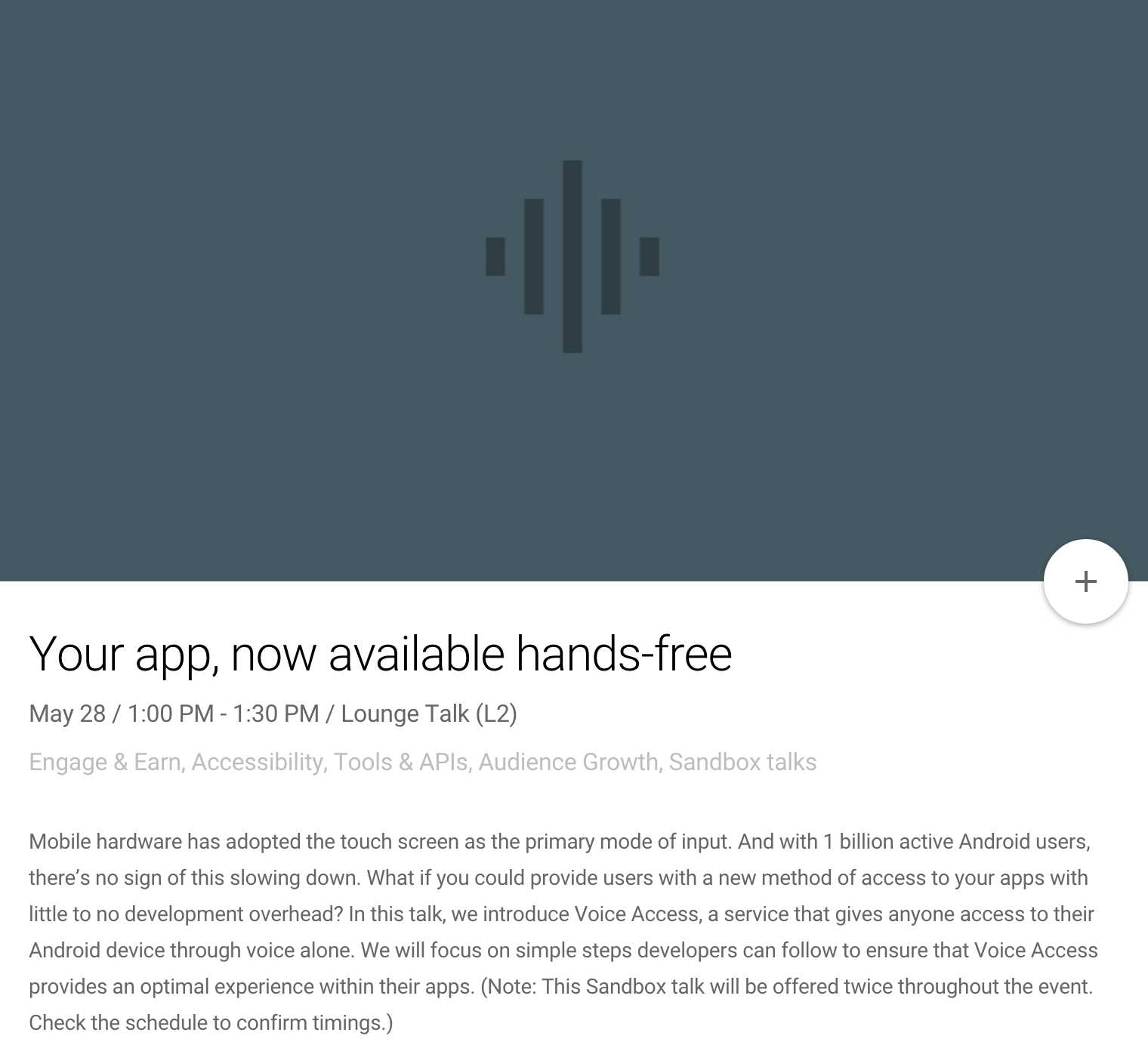
A “Voice Access” talk is also scheduled, described as “Your app, now available hands-free.” The description doesn’t reveal specifics, just that developers will be able to take advantage of the new service, presumably a feature set to debut in Android M. It sounds a bit like Google’s Voice Actions, only Voice Access wont be confined to only the Google app. Instead, Voice Access will allow developers to add voice actions inside their own apps, for truly hands-free use.
Although it wasn’t mentioned in the sessions description, it’s easy to imagine Google planning some sort of global voice actions throughout the entire Android OS, something Android M could finally bring. The convenience angle is clear, but it could be a great option for handicapped users who otherwise wouldn’t be able to interact with a touch screen device.
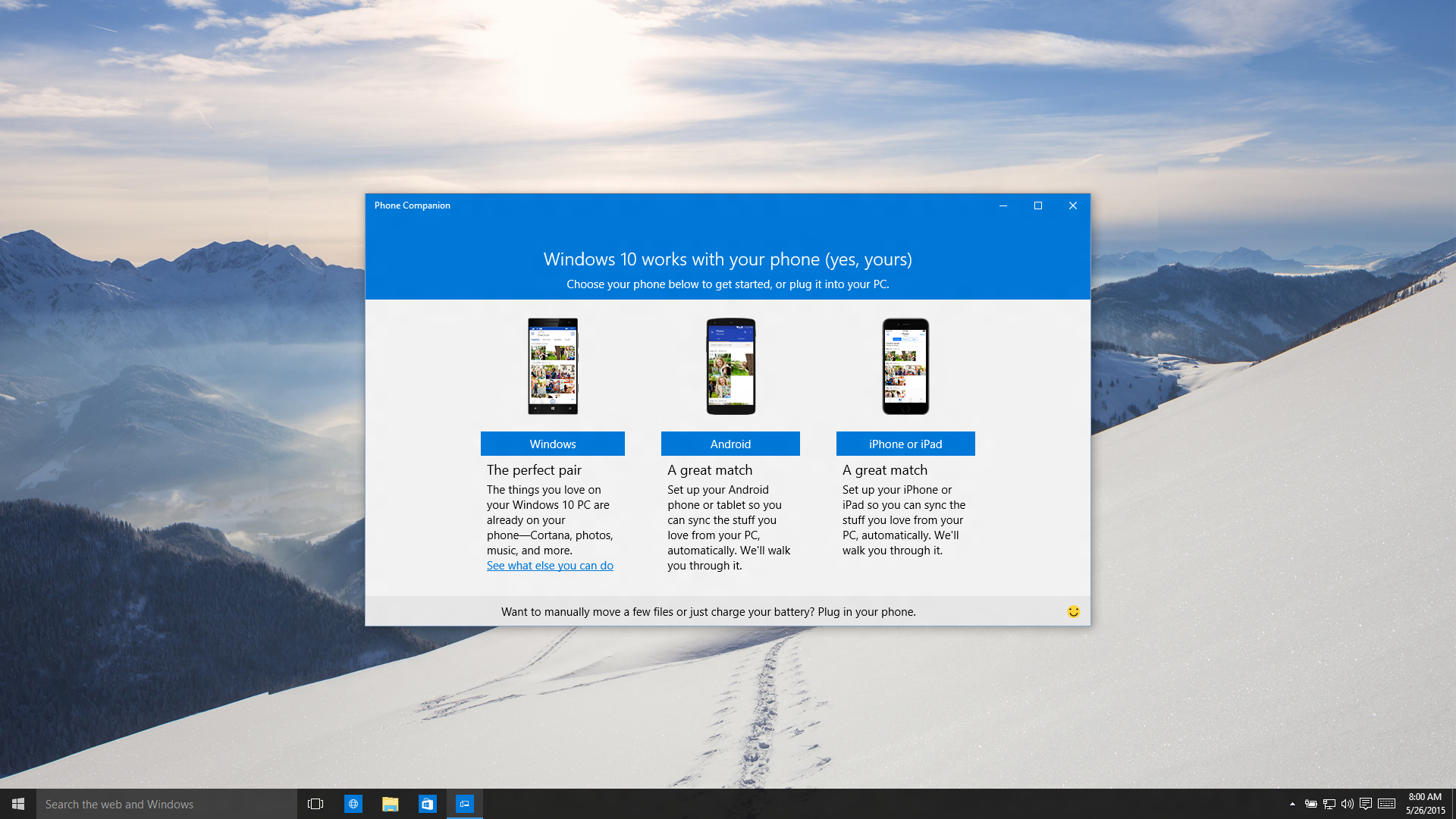
Microsoft today announced that Windows 10 will support Cortana integration not only with their own smartphone, but also for those using Android phones or the iPhone. The functionality will come as part of the OS upgrade happening later this summer.
Microsoft Cortana is a voice assistant service, not all that dissimilar to Siri or Google Search + Google Now. Cortana is actually pretty good at what it does, with some people willing to give it the throne of best voice assistant.
So what’ll it bring? Here’s a quick look at the feature set Microsoft is boasting:
You can have Cortana remind you to pick up milk the next time you’re at the grocery store, and then your phone will wake up and buzz with the reminder.
You’ll be able to ask about the weather.
Or sports scores.
Or anything else you would head to a search engine for.
You’ll be able to track a flight using Cortana on both your phone and your PC, and get the updates on the device that you’re on so you don’t miss anything.
Everything in Cortana’s Notebook will show up across all your devices and any changes you make on one device will be reflected when you use Cortana on any of your other devices.
The Cortana companion app will help you complete tasks you begin on your PC wherever you are, on your phone.
Unfortunately Android and iOS users won’t be enjoying some of the other things made possible by owning a Windows phone, such as being able to toggle settings. That sort of stuff requires more open access to system settings which Microsoft doesn’t have. Regardless, it’s better than having nothing at all.
Microsoft also detailed some of the other Windows 10 integration being worked on, including syncing your files across devices with OneDrive and being able to play music stored in OneDrive through the Xbox Music app. It all sounds great and we can’t wait for it to arrive.
So when will it happen? Microsoft says a new preview version of Windows 10 is heading out in a few weeks, and the Cortana apps for mobile should be out by the end of June. That’s not a long wait and you can bet we’ll be checking it out to see if it can’t steal us away from Google Now.
Nintendo announced in their most recent earnings call that they have a plan to launch 5 new games for “smart devices” by Spring of 2017. The first title is slated to launch this year, with others sure to be littered throughout 2016 and the early parts of 2017.
Nintendo didn’t confirm any platforms they’d be targeting, but we imagine Android won’t be left out of the fun. It’s the biggest smartphone operating system by market share, after all, and if there plans were exclusive to Apple it’s likely they would have mentioned so.
So what’s coming? Early murmurings tell us not to expect direct ports of existing Nintendo games, and there’s no guarantee anything they’re planning will take their cue from existing intellectual properties, either. Whatever the case is, Nintendo says they’re expecting to promote each game strongly and support them like the “hits” they want them to be.
The one thing we do know is that there’s no need to worry that Nintendo will be bringing some heat. The company’s track record for producing and developing quality games is near flawless, and considering they’re one of the few console makers who have their attention focused exclusively on games there’s no reason to believe they won’t do much of the same for their mobile efforts. We’re likely to hear more at E3 2015 next month, which our friends from Wii U Daily, PS4 Daily and Xbox One Daily will be attending in full force.
When HBO announced its online streaming service that doesn’t require a cable subscription — dubbed HBO Now — it was exclusive to iOS, but we quickly learned that wouldn’t be the case for very long. Thankfully that was accurate: Google has announced that HBO Now will soon be headed to Google Play.
The app should be nearly identical to HBO Go, giving you on-demand access to all of HBO’s shows and currently showing movies (and you’ll pay .99 per month for the privilege of doing so). One other thing that the Android version will get is Chromecast support, so you can beam the content to your TV with ease.
Unfortunately Google didn’t have any specifics to dish out for availability aside from the usual “later this summer,” spiel, so we’ll have to wait for further word before we know all the details. Be sure to stick with Phandroid and you’ll know the moment we do!
Yu’s first smartphone — the Yureka — wasn’t all that special aside from the fact that it ran Cyanogen OS. It was still a decent option for budget-minded folks, though, and now the company is set to follow-up with a sequel.
They have announced a May 12th date for the revelation of their next smartphone, which the promo image suggests will be called “Yuphoria”. The company is sure to use Cyanogen OS for software, though that’s as much as we know about it at this time.
Even if we don’t know what to expect we can always talk about what we want. What we don’t want? A copy/paste job based on a smartphone that already exists. We’re hoping for something unique that’ll turn heads even if its specs are unlikely to top any charts. We’ll be digging for more details, but May 12th isn’t even a fortnight away so we’ll know more soon enough.